



The neck of a person, like any animal, is an amazing part of the body, quite fragile, but powerful.
The cervical spine, along with all the muscles and ligaments, supports and moves the skull, absorbs shock when walking, protects the brain from concussions, protects the blood vessels that feed it, and also provides protection for the spinal cord.
When your neck hurts, the reasons can be quite different.Some of them may resolve on their own within a few days, while some may cause chronic illness and pain.
Why does pain occur?
The most common cause of neck pain is poor posture.With a bent back, the head stops occupying a position exactly above the body and moves forward.In this position, the muscles and ligaments in the neck experience increased tension.The development of bent and neck pain is facilitated by prolonged work without changing position, sleeping on a soft bed or high pillow and prolonged static load.
Other causes of neck pain include injury from falling head first, in a traffic accident, or while playing sports.During sudden acceleration and then braking, the cervical spine makes a whip-like motion.As a result, ligaments and muscles can become overstretched, shear or compression fractures can occur in the cervical vertebrae, and intervertebral hernias can form.
Neck pain can occur as a secondary manifestation of other diseases.For example, during a heart attack, when a heart attack causes severe pain that radiates along the nerve plexuses to the upper limbs, chest and neck.Neck pain during a heart attack is only part of a large complex of symptoms - shortness of breath, sweating, nausea, vomiting.If your neck or jaw hurts or other signs of a heart attack are observed, call an ambulance immediately.
Neck pain is also used as a diagnostic sign of meningitis.With this disease, the neck muscles become hypertonic, that is, they become stiff.When I try to tilt my head to my chest, it hurts my neck a lot.
The spine in the neck region hurts with rheumatoid arthritis, osteoporosis, fibromyalgia, spondylosis and osteoarthritis, hernia or protrusion, with compression of the nerve roots or spinal cord by infectious edema, abscesses, tumors or benign neoplasms.
Special cases
Degenerative diseases
Osteochondrosis, or in other words, degenerative disorders of the intervertebral discs, leads to a person constantly having neck pain.This is usually a mild aching pain, which is often accompanied by a feeling of numbness and tenderness in the shoulder girdle and head.
The collar zone affected by osteochondrosis can cause the development of cerebral artery syndrome.With a decrease in intervertebral distances in this area, compression injuries occur on the vertebral arteries that pass through the openings of the transverse processes of the cervical vertebrae.Pressure on the vessel causes a decrease in blood flow to the brain, causing dizziness, impaired vision and hearing.On the other hand, mechanical irritation of the artery with pressure from the vertebrae causes a reflex spasm that manifests as a burning, throbbing pain in the head.
Treatment
If your neck constantly hurts due to osteochondrosis, therapy begins with eliminating the pain syndrome.The second mandatory treatment direction is to stop the degenerative processes in the cervical vertebrae.
Pain relief can be achieved by using the following groups of medications:
- non-steroidal anti-inflammatory drugs - directly block the cascade of mediators that signal pain;
- muscle relaxants - eliminate muscle spasms that reflexively arise from severe pain;
- sedatives – calms and inhibits the nervous system and the transmission of pain impulses, including (valerian, antidepressants, sleeping pills);
- vasodilators - help eliminate vertebral artery syndrome and the pain associated with it.
To eliminate the cause of neck pain due to osteochondrosis, chondroprotective drugs are prescribed that prevent the destruction of cartilage and vertebrae, as well as multivitamin-mineral complexes.
Pain treatment also consists of exercise therapy, physiotherapy, massage, traction, zone therapy and tape therapy.During an exacerbation, to relieve pain, the patient is recommended to wear a special collar that protects the neck from excessive mobility.
Muscle pain
Pain in the neck can occur due to inflammation of the neck muscles, called myositis.Such pain should be distinguished from neuritis (inflammation of the nerve trunks with sensitivity disturbance) and pain caused by osteochondrosis.Myositis occurs suddenly, after exposure to predisposing factors - hypothermia, vibration, prolonged overexertion, especially with prolonged repeated movements of the same type.
Cervical myositis is characterized by acute pain that occurs when the inflamed muscle contracts.The sharp severity of pain leads to difficulty in performing certain types of movements.Usually, the long neck muscles on the anterolateral surface or the sternocleidomastoid muscles hurt, which, when contracted bilaterally, retract the head, and when contracted unilaterally, rotate it.Also often inflamed are the deep muscles that surround the spine and move the entire neck and back.
When palpating the muscle, its increased tone and dense nodular areas are noted.Disruption of microcirculation and local trophism lead to gradual replacement of myocytes with connective tissue.As a result, the neck muscles weaken, their symmetry on the sides of the spine is disturbed, "torticollis" may occur, and it is difficult for the patient to keep his head straight.
Treatment
The treatment begins with reducing the load on the neck.This is followed by a course of physiotherapeutic procedures - UHF heating, electrophoresis with drugs, paraffin heating, ozokerite wrapping, diathermy, massage, acupuncture.Such procedures restore blood circulation in the neck muscles.Medicines include injections of B vitamins, anti-inflammatory and pain relievers, ointments and rubs.
Traditional treatment recommends using cabbage or burdock leaves as pain-relieving compresses, preparing an ointment from crushed willow buds in butter, and making rubs of a mixture of turpentine with apple cider vinegar and egg yolk.The neck is also rubbed with lava oil and then wrapped.The key to the success of any treatment is to rest the sore neck until its muscles are fully restored.Then you need to start bringing them back "to service" through special gymnastics and massage.
Radicular syndrome
Severe pain in the neck, which spreads to the muscles of the head, shoulder girdle, upper limbs, can occur when the roots of the spinal nerves are pinched due to prolapse, protrusion or herniated intervertebral discs.
With this disease, protrusion of the inner core of the disc against the spinal canal or its lateral horn occurs.A hernia and its symptoms usually appear on one side.When pressure is created on the roots of the spinal nerves, a burning, sharp pain occurs in the innervated muscles (cervical lumbago).The patient feels numbness in the lower jaw, the area around the ears, the back of the head, the shoulder blades and the arms.Dizziness and sharp pains in the neck occur when you change position from horizontal to vertical.Gradual protrusion of the disc core leads to trauma in surrounding tissues, their inflammation and swelling.This creates the conditions for inflammation of the nerve endings with the development of radiculitis, and the mobility of the neck and upper limbs is gradually limited.Prolonged compression of the spinal nerves leads to paresis or paralysis of the limbs.
Therapy
What to do if your neck hurts because of a hernia?At home, for pain, painkillers, non-steroidal anti-inflammatory drugs, hormonal drugs and muscle relaxants are taken to relieve spasms.
In the hospital, severe neck pain is eliminated with the help of "blockades" - injection of painkillers on the sides of the spine.
Swelling and inflammation are eliminated with steroid medication, which can be injected directly into the hernia area.Muscle soreness is eliminated by taking muscle relaxants.
Also, to prevent further development of the hernia, I use drugs that strengthen cartilage tissue - chondroprotectors.
In many cases, therapeutic exercises and traction in the cervical spine help with protrusion or slight protrusion.Increasing the intervertebral space helps to "retract" the intervertebral disc and relieve pressure on the nerves.
In true hernias with rupture of the fibrous ring and prolapse of the core into the spinal canal, surgery is necessary.There are several ways to get rid of neck pain through surgery:
- anterior cervical discectomy - removal of an excess piece of disc that presses on the spinal nerves;
- replacing a damaged disc with an artificial joint, which protects the cervical spine from further destruction;
- microendoscopic discectomy using a posterior approach and removing small areas of the hernia through an endoscope;
- Posterior cervical discectomy through an incision in the neck.The operating channel is specially enlarged so that pinching does not develop in the future.
Neoplasms
If there is constant pressing pain in the neck, you can suspect the appearance of a foreign formation in this department.
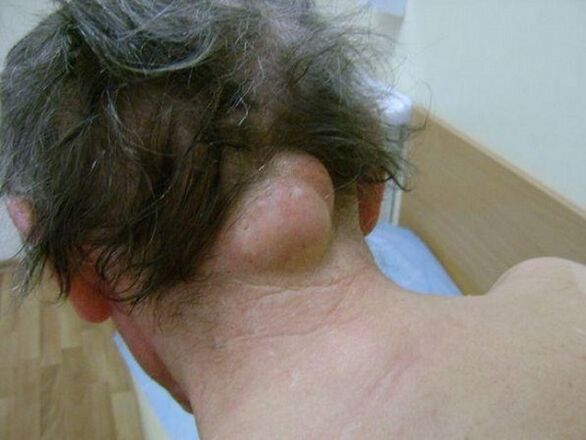
Benign tumors (lipoma, fibroma, neuroma, osteoma, hemangioma) most often have a regular shape and are clearly defined;they rarely cause pain.Discomfort is mainly associated with compression of surrounding tissue by the tumor.Malignant tumors (osteogenic sarcoma, myeloma, cancer of the lymph nodes or thyroid gland) have no borders and give many metastases to neighboring tissues.Their destructive effect on organs causes a painful sensation and a general deterioration of the condition.The front of the neck can become painful due to cancer of the larynx, pharynx, oral cavity or thyroid gland.The patient experiences difficulty swallowing, swelling of the neck and face and a change in voice.If the cervical spine hurts due to a bone tumor, then this condition is also often accompanied by damage to the spinal cord and nerve roots on the side of the spine with the development of paralysis.
Treatment
Treatment of pain due to tumors is primarily aimed at eliminating the cause - reducing or removing the tumor.For this purpose, chemotherapy and radiation therapy, sclerosis of the vessels feeding the tumor and surgical removal of the pathological formation are used.
Pain relief depends on the severity of the pain:
- weak substances;
- moderate pain medication;
- with increasing pain they switch to weak opiates;
- in case of severe pain, analgesia is only possible with the help of opiate drugs.To improve analgesia for neck pain due to neoplasms, antipsychotics, anticonvulsants and corticosteroids are used.
Pay attention!Neck pain can occur for various reasons.In order not to miss serious diseases, you must first visit a doctor for a consultation about the occurrence of pain and accurately determine its source.